
Updated 7 October 2026. 2026 figures, with the 2027 and 2028 reform included.
The short answer. Health insurance is compulsory in Germany. Employees are covered by statutory insurance (GKV) as long as their gross annual salary stays below €77,400 (the 2026 threshold). Above it, and for most self-employed people, there is a choice between the GKV and private health insurance (PKV). The GKV sets your contribution by income, the PKV by age and health. In 2027 the threshold rises by a further €3,600 on top of the usual adjustment.
The email from HR
The employment contract is signed. A few days later, HR gets in touch: “Please let us know which health insurance fund you belong to.”
Depending on where you come from, you may be used to a single compulsory scheme with a top-up policy, a basic cover bought from private insurers, or a tax-funded system. Germany follows none of these models. Two systems run side by side, and the question arrives with no warning.
The instinct is to find the cheapest option or to copy a colleague. That rarely ends well: the two systems follow different logic, and depending on your situation you may not have a choice at all.
Who gets to choose?
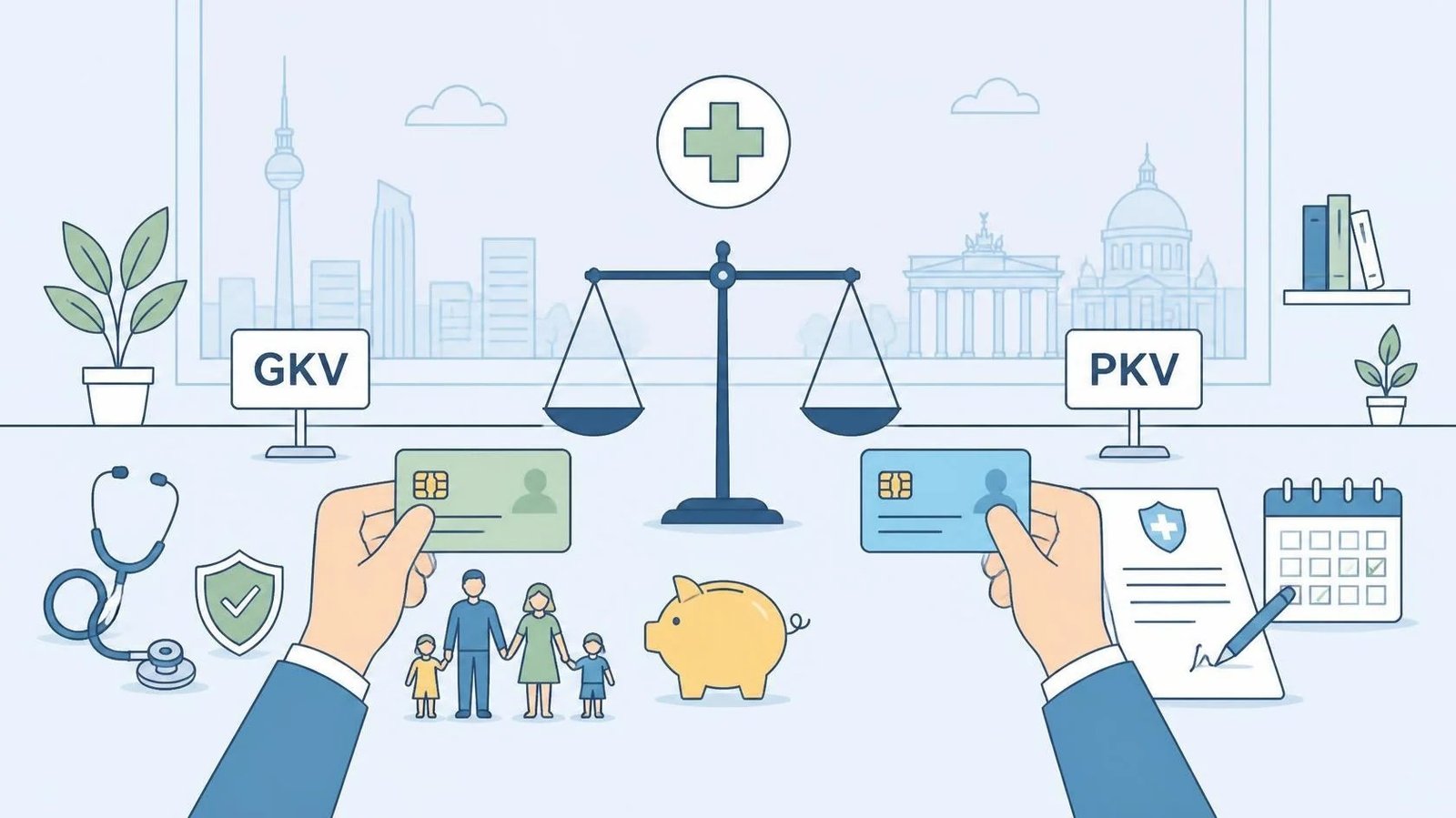
The GKV is statutory (public) health insurance. The PKV is private health insurance. Which one is open to you depends on your employment status.
| Situation | What applies |
|---|---|
| Employee earning under €77,400 gross a year (2026 threshold) | GKV is compulsory |
| Employee above that threshold | Choice between voluntary GKV and PKV |
| Self-employed and freelancers | Free choice in principle |
| Students, people not working, posted workers | Special rules, assessed case by case |
A good salary below the threshold does not open the door to the PKV. Cover from your home country (basic insurance, the European Health Insurance Card, an expat policy) does not normally replace German insurance if you work under a German employment contract. Depending on the country and your situation it can bridge a short transition, but it does not release you from the obligation to be insured in Germany.
How the two systems work
The GKV looks at what you earn, the PKV at who you are.
In the GKV, your contribution is a percentage of your salary up to a ceiling, and your employer pays half. Children are covered at no extra cost, and so is a spouse without income, for now. Benefits are the same for everyone and set by law.
In the PKV, the premium depends on your age when you join, your health and the level of cover you choose. Every insured person pays their own premium, spouse and children included. What is covered is written into the contract.
| GKV | PKV | |
|---|---|---|
| Basis of the contribution | Income | Age, health, cover |
| Children | Covered at no extra cost | Own premium for each child |
| Spouse without income | Covered at no extra cost (surcharge from 2028 under conditions) | Own premium |
| Benefits | Set by law | Set by the contract |
| Health questionnaire | No | Yes |
| Going back | Possible in many cases | Very limited, especially after 55 |
When the GKV is the better fit
For many employees, staying in the GKV is the most solid choice.
Families with a single income gain the most: children and a spouse without income are covered with no additional contribution, whereas the PKV charges each person separately. If your income fluctuates, a contribution that follows your salary suits you better than a fixed premium that is due even in a bad year. The same goes for anyone planning to move to part-time work, unsure how long they will stay in Germany, or seeing doctors regularly: the GKV asks no health questions and does not tie you down for the long term.
When the PKV can make sense
The PKV can suit young, healthy people with no plans for children soon and a high, stable income. It is also an option for anyone who wants specific benefits fixed in a contract, and for self-employed people who want to tailor their own cover.
Two caveats apply even then. The entry premium is not tomorrow’s premium: it changes with age and with the insurer’s tariff adjustments. And getting out is hard: moving from the PKV back to the GKV is possible only in certain cases, for example if income falls below the threshold, and becomes very limited after 55.
What the premium does not tell you
Four points tend to get lost in comparisons, because they do not show up in the monthly premium.
Same price, different protection. In the PKV, every tariff sets its own reimbursement limits, hospital conditions, dental benefits and deductible. A low premium often means narrower cover or a higher deductible.
Illness is covered differently. In the GKV, the fund pays sickness benefit (Krankengeld) after six weeks of incapacity for work. The PKV has no such income replacement by default: a daily sickness allowance (Krankentagegeld) has to be bought on top, and it costs extra.
Premiums do not stay put. Private insurers can adjust premiums within rules set by law. How a tariff develops over the years is part of the offer.
A signed contract can be reviewed. There are ways to change a PKV contract or have it checked. That has its own article: Already have a private health insurance contract? How to review it.
What changes in 2027 and 2028
The law stabilising contribution rates in statutory health insurance, published in the Federal Law Gazette on 29 July 2026, directly changes this decision.
The threshold above which employees can move to the PKV rises in 2027 by a one-off €3,600 on top of the usual annual adjustment. Someone who would have crossed the old threshold but not the new one stays in the GKV. The GKV contribution ceiling goes up by the same amount, so the maximum contribution rises for high earners who stay in the GKV.
Employees who, on 31 December 2026, are exempt from statutory insurance because they are over the threshold and hold a full private health policy are not affected by this one-off increase. A supplementary policy alone does not qualify.
From 1 January 2028, a spouse who is currently covered free of charge in the GKV will trigger a surcharge of 2.5 percentage points on the member’s contribution rate. Children remain covered at no cost. The surcharge does not apply in certain cases, among them a child under 12 living in the household, care of a relative, or a disability.
The exact 2027 figures will be set by decree in the autumn. This page will be updated then.
What does it cost?
The GKV is easy to calculate. An employee pays 8.75% of gross salary (half of the 14.6% general rate plus the 2.9% average additional contribution), up to the contribution ceiling of €69,750 a year in 2026. The amounts below exclude long-term care insurance.
| Situation | GKV contribution per month |
|---|---|
| Employee, €50,000 gross a year | €364.58 |
| Employee, €69,750 gross a year or more (ceiling) | €508.59 |
| Self-employed, voluntarily insured, at the ceiling | €1,017.19 |
Above the ceiling, the contribution stops rising. That is why the GKV gets relatively cheaper as salaries go up, and why the PKV question comes up mainly for high earners.
The PKV has no standard price. The premium comes from several factors working together:
| What affects the PKV premium | Effect |
|---|---|
| Age when you join | The later you start, the higher the entry premium |
| Health | Can lead to a surcharge or exclusions |
| Level of cover | The broader the reimbursement, the higher the premium |
| Deductible | The higher it is, the lower the premium |
| Daily sickness allowance | Added on top, depending on amount and start date |
| Number of insured people | One premium per person, children included |
| Insurer and tariff | Large differences at comparable cover |
| Employer contribution (employees) | Reduces the share you pay, up to a maximum |
That is why a single figure would be misleading: the same person can get very different offers depending on the cover and deductible chosen. The only reliable comparison is made on your own profile, with defined and identical cover. A first conversation gives you exactly that calculation, with no obligation.
Five questions before you decide
- Is your income above the threshold, and will it still be in 2027?
- Do you have children or a spouse without income, or will you soon?
- How long do you expect to stay in Germany?
- Is your income stable or variable?
- Have you compared several insurers at equivalent cover?
Compare on your own profile
Feller Financial Advisory works with several insurers and compares on each person’s actual profile. The first conversation lasts about an hour and is free. It can be used to compare offers at equivalent cover, or to go through a contract you have already signed. Adrien Feller’s background is on the About page, and the support offered to individuals on the Individuals page.
This article is general information. It is not personal advice or a product recommendation. Amounts, thresholds and rules change every year, so always check the current position. For tax questions, a tax adviser (Steuerberater) is the right contact.
Sources
- Bundesgesetzblatt 2026 I No. 228, law stabilising contribution rates in statutory health insurance, published 29 July 2026 (§ 6, § 223, § 242b SGB V)
- Social insurance reference values 2026 (federal government decree): threshold of €77,400, contribution ceiling of €69,750
- General contribution rate and average additional contribution 2026: GKV-Spitzenverband
Frequently asked questions
What income do you need to be able to move to the PKV?
Gross annual salary must exceed a threshold set each year: €77,400 in 2026. In 2027 the threshold rises by a further €3,600 on top of the usual adjustment, and the exact figure will be set by decree.
Can self-employed people choose freely between the GKV and the PKV?
In principle yes, between voluntary statutory insurance and private insurance. In the GKV, the contribution depends on income, with a minimum.
Are children and a spouse covered free of charge in the PKV?
No, every person has their own premium. In the GKV, children are covered at no cost, and a spouse without income is too until 2028. After that a surcharge applies, unless one of the legal exceptions is met.
Can you go back to the GKV after moving to the PKV?
In certain cases, for example if income falls below the threshold. After 55, going back is in principle very limited. The rules for switching changed in January 2026, so your own situation needs to be checked.
How much does private health insurance cost in Germany?
There is no standard price. The premium depends on your age when you join, your health, the level of cover, the deductible, the daily sickness allowance, how many people are insured and the insurer. In the GKV, an employee pays 8.75% of gross salary up to a ceiling (€508.59 a month at the 2026 ceiling, excluding long-term care). A fair comparison only comes from a calculation on your own profile.
Does the reform change the choice between the GKV and the PKV?
It can: the threshold rises in 2027, so does the GKV contribution ceiling, and from 2028 a spouse without income triggers a surcharge. If you are close to the threshold or have a family, it is worth redoing the comparison.
Can you still question a private health insurance contract you have already signed?
Yes, within limits: withdrawal within 14 days, a tariff change with the same insurer, a change of insurer or termination. Each option has consequences, which are covered in the article on reviewing an existing PKV contract.