
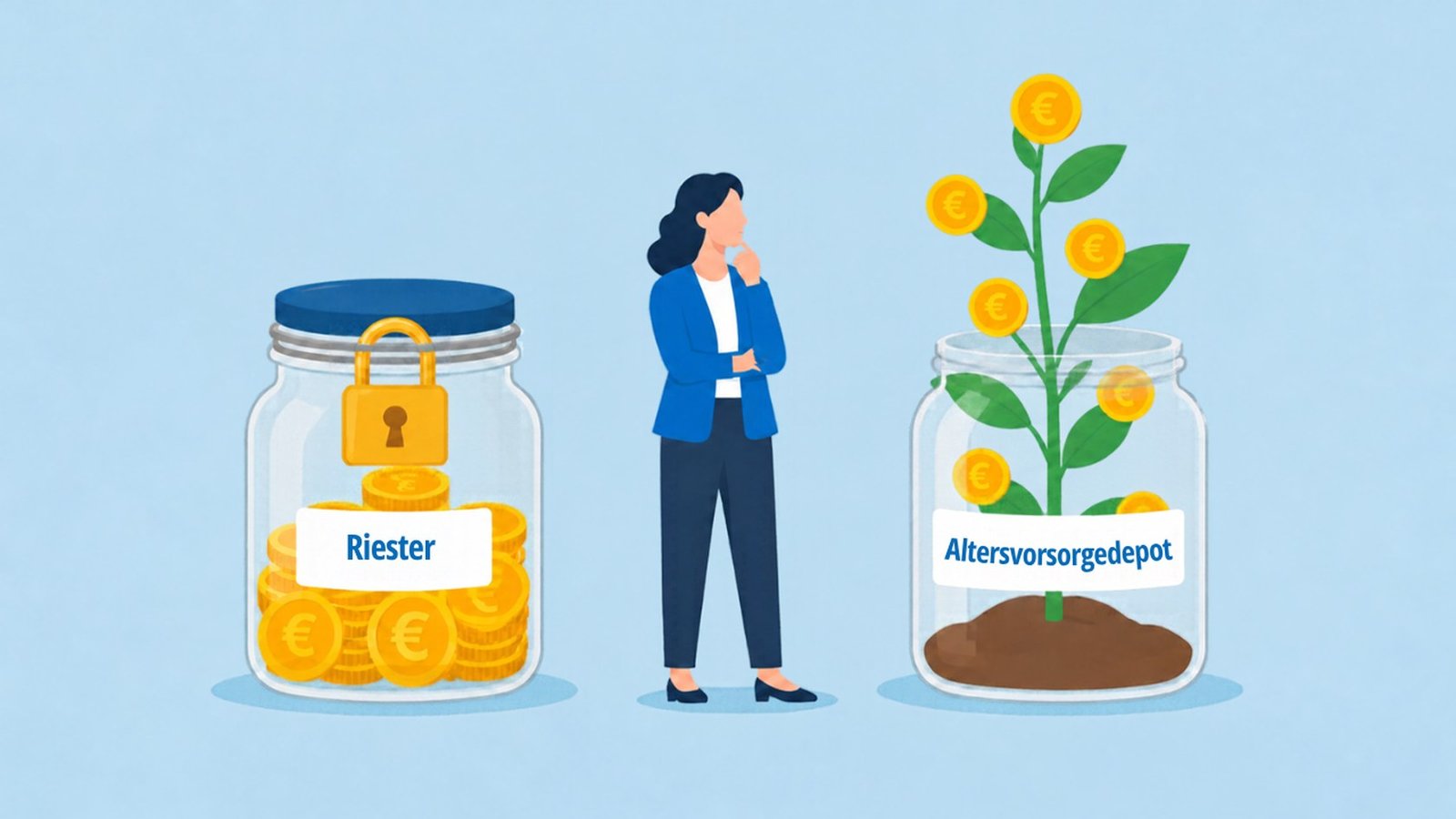
You signed a Riester contract a few years after moving to Germany. Since then, a payment has gone out every month, and you are not really sure what it earns you. In January 2027, banks, online brokers and insurers will start offering you the new Altersvorsorgedepot, often in a few clicks.
Nothing forces you to act. But some steps, once taken, cannot be undone. This article sets out your options for your Riester contract and what to check before you choose.
To understand the new product itself (subsidies, fees, payout), start with my Altersvorsorgedepot 2027 guide.
Your Riester contract stays valid
A Riester contract signed before 1 January 2027 keeps its existing rights (Bestandsschutz). You can carry on exactly as today, under the old subsidy rules (source: Federal Ministry of Finance, BMF). There is no automatic cancellation and no automatic conversion (source: Federal Government).
You also keep the right to pause your contract (ruhen lassen): the law requires it for old and new contracts alike (source: BMF).
This protection gives you time to compare: nothing forces you to decide on 1 January. What matters is not to sign anything before you have compared.
The four options for your contract
The reform leaves you four possibilities (source: BMF).
1. Carry on unchanged
Your contract and your payments stay the same, under the old subsidy rules. The capital stays where it is.
2. Keep the contract, switch to the new subsidy rules
A simple declaration to your provider is enough; the provider does not have to agree. The terms of the contract stay the same; only the way subsidies are calculated changes.
3. Transfer to a new contract
Your capital moves to an Altersvorsorgedepot or a guaranteed product, under the new rules. You do not repay the subsidies already received, but switching, sales and distribution costs may apply.
4. Stop paying in and open a new contract
The old contract is paused and the capital stays there until retirement. Your new payments go into the new contract, under the new rules. Be aware: you then move to the new subsidy rules, including for the old contract, although its original terms (guarantee, any guaranteed interest rate) remain intact (see below).
Once you have left the old subsidy rules, there is no way back (source: BMF). That is why the order of your decisions matters.
The trap: opening an Altersvorsorgedepot alongside your Riester
Many savers plan to keep their Riester as it is and simply open an Altersvorsorgedepot on top. That is allowed: the law permits up to two new contracts alongside the old one. But as soon as you sign the new contract, you move to the new subsidy rules, and your Riester loses its protected status (source: BMF).
In practice, your old contract no longer falls under the old subsidy rules, and you cannot go back. Opening an account online takes a few minutes; this consequence is permanent.
What changes is the way subsidies are calculated, not the contract itself: the guarantee and any guaranteed interest rate stay in place as long as you neither transfer nor cancel. If the old contract is paused, losing the old rules costs it nothing. The trap concerns people who intend to keep paying into the old contract, and above all lower earners: the old rules gave them the full subsidies for a small payment (see example 3 below).
Transferring the capital (option 3) calls for a different check. When you leave your contract, you also leave its terms: guarantees, any guaranteed interest rate on an older insurance contract, built-in options. Before you tick “transfer my Riester” on a form, know what those terms are worth.
Cancelling to get the money: the most expensive option
Cancelling your contract to have the capital paid out is not the same as a transfer. For the tax authorities, it is a harmful use (schädliche Verwendung) of subsidised savings (source: BMF; Income Tax Act, § 93 EStG).
- The subsidies must be repaid: all of those received while saving, plus the tax savings obtained through the tax deduction (source: BMF; § 93 EStG).
- The gains are taxed: the amount paid out, minus the subsidies, is taxable for the part that corresponds to the contract’s gains (source: § 22 no. 5 EStG). Your tax adviser (Steuerberater) can put a figure on this for your case.
- The guarantee disappears: you get the current value, after the costs already deducted. On a contract at a loss, the loss becomes final.
For a saver with two children who received the full subsidies for ten years, the subsidies alone to be repaid come to €7,750. On top of that come the tax savings obtained, often significant on a high income, and then the tax on the gains.
If you need flexibility, other routes avoid this repayment: pausing the contract (the subsidies already received are kept), transferring the capital to another certified contract (option 3) or, for a home purchase, using the withdrawal allowed for owner-occupied housing (Wohn-Riester).
Is your contract at a loss?
This is the first thing to check. According to the consumer advice centre of Baden-Württemberg (Verbraucherzentrale), Riester contracts often remain in the red for years after signing, mainly because of acquisition costs.
Why? The law requires the provider to guarantee that, when retirement payments start, at least the contributions paid in will be available (source: AltZertG, § 1). To keep that promise, some providers sold equity fund units at the bottom of the 2008 and 2020 crashes and moved savings into bonds. According to the same Verbraucherzentrale, in its statement to the Bundestag, the 2022 interest rate rise then caused price losses of up to 50%.
The key point: this guarantee only applies when retirement payments start. If you transfer your capital before then, you leave with its current value. A paper loss becomes a real loss, and the guarantee of the old contract disappears.
That does not mean you should always stay. A contract stuck in bonds can also take years to recover. But the decision should be made knowing this figure.
How to check: every year, your provider must tell you in writing the capital built up, the actual costs of the past year, the returns achieved and, for more recent contracts, the capital expected at the start of payments (source: AltZertG, § 7a). Compare the current capital with your payments plus the subsidies received.
What a switch costs
A transfer is not a cancellation with a payout: you ask for the capital to move directly from your current contract to the new one. In general, the new provider handles the request with your current provider. Legally, it is a termination for the purpose of transfer, with three months’ notice to the end of a calendar quarter (source: AltZertG, § 1). Never ask for the money to be paid out to you: that would be a cancellation, with the consequences described above.
Possible costs:
- Your current provider: if your contract is less than five years old, it may charge at most €150 for the transfer. After five years, the transfer is free (sources: AltZertG, § 1, version in force from 1 January 2027; BMF).
- The new provider: a one-off administration fee of at most €150. It may not calculate acquisition and distribution costs on the subsidised capital you transfer. Those costs may, however, apply to your future payments, spread over the whole savings period (sources: AltZertG, § 1, 2027 version; BMF).
- Costs already paid on the old contract: you do not get them back. In a Riester contract, acquisition and distribution costs are spread over at least the first five years (source: AltZertG, § 1). On an older contract, much of them has therefore already been paid: what matters from now on is the costs still to come.
To find out the costs of your contract, go back to the product information sheet (Produktinformationsblatt) handed to you at signing (for contracts signed since 2017): it sets out the costs and the conditions for switching and cancelling (source: AltZertG, § 7). Your annual statement shows the costs actually charged last year.
The same rules apply to later switches within the new system (source: BMF).
Old or new subsidy rules: what to compare
The two systems do not calculate subsidies the same way. Depending on your income and your family, one can pay noticeably more than the other.
| Criterion | Old rules (Riester) | New rules (2027) |
|---|---|---|
| Basic subsidy | €175 a year | The state adds 50 cents per euro paid in up to €360 (i.e. €180), then 25 cents per euro from €361 to €1,800 (up to €360 more). Maximum: €540 a year. |
| Per child | €300 (born from 2008) or €185 (born before) | The state adds €1 per euro paid in, up to €300 per child. |
| To get it in full | Pay in 4% of the previous year’s income (€2,100 maximum), minus the subsidies, and at least €60 a year. Otherwise subsidies are reduced pro rata. | At least €120 a year. The subsidy follows what you pay in. |
| Tax deduction cap | €2,100, subsidies included | Up to €1,800 of your own payments, plus the subsidies |
| Guarantee | At least the contributions paid in | 100%, 80% or none, depending on the product |
| Earliest payout | Age 62 (60 if signed before 2012) | Age 65, earlier if you already draw a statutory pension |
Sources: BMF; Finanzamt NRW for the Riester minimum contribution.
Example 1: a manager earning €80,000 gross, two children born from 2008. The new rules win. Under the old rules, he must pay in €1,325 a year to receive €775 in subsidies. Under the new rules, paying in €360 is enough to receive €780, and if he keeps paying €1,325, he receives about €1,021. At this income level, the tax deduction often matters more than the subsidies, and its cap rises too (see the table).
Example 2: a married couple, she works part-time for €36,000 gross, three children. A draw. As is common for married couples, she receives the child subsidies. Under the old rules, she must pay in €365 a year to receive €1,075. Under the new rules, the same €365 brings in €1,081. The difference is negligible: the choice will come down to other criteria (guarantee, costs, age, plans).
Example 3: a married couple, she went back to work half-time for €24,000 gross, two children. The old rules win. Under the old rules, paying in €185 a year brings her €775. Under the new rules, the same €185 brings in only about €463, and she would have to pay in €350 to get back to €775. Here, keeping the old rules is clearly better.
In both systems, the tax office also checks whether a tax deduction is more favourable to you than the subsidies (source: BMF). If your spouse also has a contract, or opens one through your entitlement, their situation enters the calculation too.
I can run this calculation with you, on your own figures, in a first conversation.
Your age and the time left before retirement
Age matters in two ways.
The age at which the money becomes available. A Riester contract can start paying out at 62, or at 60 if it was signed before 2012 (source: Deutsche Rentenversicherung). In the new system, payments start at 65 at the earliest, unless you already draw a statutory pension (source: BMF). If you are thinking of stopping work early, this point matters before any transfer.
The number of saving years left. The further away retirement is, the more time subsidies and returns have to build up, and the more time an unguaranteed investment has to ride out downturns. A few years before retirement, the guarantee of your old contract and its current value weigh more. The new standard product reflects this: it automatically shifts savings into the more cautious fund in the years before retirement (source: BMF).
If your contract is at a loss. Close to retirement, keeping it is often the more prudent choice: the guarantee will return at least your contributions when payments start, whereas a transfer locks in the loss. Early in your career, the question looks different: an equity investment has more years ahead to make up the loss and aim for a long-term gain, with no certainty and with possible falls along the way.
Three common situations for internationals in Germany
You became self-employed. You may have stopped paying into your Riester when you left salaried employment, because you were no longer entitled to subsidies. From 2027, self-employed people with business income or professional income under § 15 or § 18(1) nos. 1 to 3 EStG who have filed a tax return become directly eligible (source: BMF). The question is no longer whether you can be subsidised, but through which contract.
You are a doctor, dentist, lawyer, architect or notary with a professional pension fund (Versorgungswerk). Compulsory members of a professional pension fund become eligible too. One practical condition: give your fund your consent, by the end of the contribution year at the latest, so that it passes your details to the body that pays the subsidies, the ZfA (source: BMF).
You are planning to buy your home. Until now, every Riester contract had to allow you to withdraw capital for a home you live in yourself (Wohn-Riester). In the new system, this becomes an option the provider may or may not offer (source: BMF). If you have a property project, check this point before any transfer.
If you might retire outside the EU
If you live outside the European Union and the European Economic Area from the start of payments onwards (including if you move away during retirement), you must repay the subsidies and tax benefits received while saving (source: BMF; § 95 EStG). The rule also applies if you live in the EU but are treated as resident outside the EU/EEA under a tax treaty.
Retiring in another EU or EEA country, such as France, Spain, Italy, the Netherlands or Norway, does not trigger this. Retiring in the UK, Switzerland, the United States, Canada or India does. If retiring outside Europe is a real possibility, take it into account before increasing your payments, whichever subsidy rules you choose.
Questions to ask yourself before deciding
- Is your contract worth more or less than your payments plus the subsidies received?
- How much in subsidies do you receive today, and do you pay in the minimum needed to get them in full?
- What type of contract do you have (insurance, fund savings plan, bank savings plan), and what does it guarantee?
- What costs remain if you keep it, and what would a switch cost?
- At what age do you want to draw on these savings, and how many years away is that?
- How many children entitle you to child benefit (Kindergeld), and does your spouse also have a contract?
- Are you planning to buy a property?
- Where do you expect to live in retirement?
None of these questions decides on its own: it is the combination that tips the balance towards one of the four options. The answers are in your contract, your annual statement and your subsidy notices.
Before signing anything in January, take the time to review your situation. At Feller Financial Advisory, I go through your Riester contract with you, in English, French or German, and we compare the options on your actual situation. Book a first conversation
Frequently asked questions
Do I have to cancel my Riester contract in 2027? No. Contracts signed before 1 January 2027 can continue under the old subsidy rules (source: BMF).
What happens if I cancel my Riester to get the money? You repay all the subsidies and tax savings received, and the contract’s gains are taxed (source: BMF; §§ 93 and 22 EStG). Pausing the contract or transferring the capital avoids these consequences.
Can I transfer my Riester to an Altersvorsorgedepot without losing the subsidies? Yes. You do not repay the subsidies already received, but switching, sales and distribution costs may apply (source: BMF).
Can I keep my Riester and open an Altersvorsorgedepot as well? Yes, up to two new contracts. But your old contract then loses its protected status and moves to the new subsidy rules (source: BMF).
How much does transferring my Riester cost? From 2027, your current provider cannot charge anything if your contract is more than five years old, and at most €150 otherwise. The new provider may charge a fee of at most €150, with no acquisition costs on the subsidised capital transferred (sources: AltZertG, § 1, 2027 version; BMF). The notice period is three months to the end of a quarter.
My contract is at a loss: should I transfer it? Not without thinking it through. The Riester guarantee ensures that at least your contributions will be available when retirement payments start (source: AltZertG, § 1). If you transfer before then, you leave with the current value.
Can I go back to the old subsidy rules after switching? No, that is not possible (source: BMF).
What happens if I move outside the EU in retirement? If you live outside the EU/EEA from the start of payments onwards, the subsidies and tax benefits received must be repaid (source: BMF).
This article is for information only and does not constitute personal advice. It is based on the FAQ of the German Federal Ministry of Finance as of 9 November 2026. Implementing rules may still change.
Comments
One response to “Riester contract: what to do in 2027, now that the Altersvorsorgedepot is here”
[…] Existing Riester contracts are not disappearing. They keep their grandfathered rights (Bestandsschutz) and continue to run as before. You can also move your contract to the new subsidy rules, or transfer its capital to a new contract without repaying the subsidies already received (source: BMF). The options and their pitfalls are covered in my article on Riester contracts in 2027. […]